How to Read Yarn Labels: A Complete Guide
Decode every number, symbol, and code on a yarn ball band — yardage, weight category, gauge, dye lot, care symbols, and fiber content explained.
How to Read Yarn Labels: A Complete Guide
The yarn label — also called a ball band or skein tag — tells you everything you need for a successful project. But it's packed with numbers, symbols, and abbreviations that aren't always obvious to new crafters. Once you know what to look for, reading a label takes about 10 seconds and saves you from buying the wrong amount or ruining a finished project in the wash.
This guide breaks down every element of a yarn label and explains why each matters.
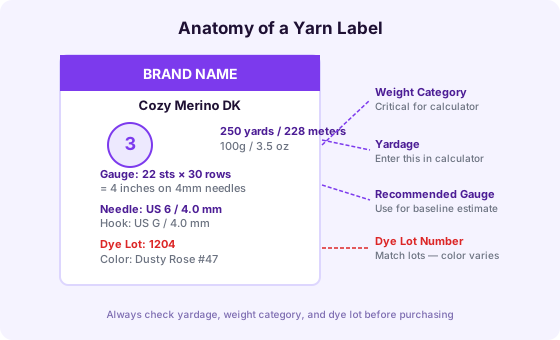
Annotated yarn label diagram showing where to find yardage, weight category, gauge, dye lot number, and needle/hook size
The Weight Symbol
The most important item on the label is the weight category symbol — a square with a skein icon and a number from 0 to 7. The number tells you the yarn's thickness category according to the Craft Yarn Council's standard system:
- 0 — Lace
- 1 — Fingering/Sock
- 2 — Sport
- 3 — DK/Light Worsted
- 4 — Worsted/Medium
- 5 — Bulky/Chunky
- 6 — Super Bulky
- 7 — Jumbo
This number is the first thing to enter in the yarn calculator — it determines the default gauge and yards-per-square-inch estimate that drives the calculation. Our yarn weight guide covers what each category means in practice.
Yardage and Weight
You'll see two numbers side by side: yardage and skein weight. They might look like "220 yds / 100 g" or "220 yards / 3.5 oz." Both measure the same skein.
Yardage is what you enter in the yarn calculator's "Yards Per Skein" field. If the label shows only meters, multiply by 1.094 to get yards — or just enter the meter value and note that our results are in yards.
Skein weight (in grams or ounces) is useful for buying by weight when yardage isn't listed, and for estimating shipping costs if you're ordering online. Don't confuse the skein's physical weight with the yarn's weight category — these are completely different concepts.
Recommended Gauge
The label usually shows a suggested gauge — something like "18 sts × 24 rows = 4 in on US 8 needles." This is a starting point, not a guarantee. The listed gauge is based on the manufacturer's sample swatch, typically worked in stockinette.
Your personal gauge will differ based on your tension, your specific needle or hook, and the stitch pattern you're using. Use the label gauge as a default when you don't have your own swatch data, but for accuracy on large projects, measure your own gauge and enter it in the yarn yardage calculator.
Recommended Needle and Hook Size
The label lists a recommended needle size (in US and metric) and often a crochet hook size too. These are calibrated to achieve the suggested gauge. If your gauge is too tight (too many stitches per inch), go up a needle size. If it's too loose (too few stitches), go down.
Needle and hook sizes are a recommendation, not a rule. The gauge you achieve matters far more than the needle you use to get there.
Dye Lot Number
The dye lot number is printed on most labels — it might say "Dye Lot: 1204" or just a barcode with the lot embedded. This is a production batch code.
Yarn is dyed in batches. Even for the same color, different dye lots can have subtle color shifts — slightly warmer, slightly cooler, slightly lighter. In a single skein, the difference is invisible. Across a project that alternates skeins from different lots, it can show as a visible stripe.
Always buy all your skeins for a project at once, from the same dye lot. Check each label before purchasing. If you're buying online, note that some sites don't guarantee same-lot shipping — ask customer service before ordering large quantities.
If you run out of yarn mid-project, alternate rows with the new dye lot every two rows instead of switching cold — this blends the color shift gradually and makes it much less visible.
Fiber Content
Fiber content is listed as a percentage breakdown — like "100% superwash merino" or "75% wool, 25% nylon." This affects:
- Care instructions (superwash wool is machine washable; untreated wool is not)
- Drape and stretch (cotton has no stretch; wool bounces back)
- Price (cashmere and silk cost more than acrylic)
- Allergies (some people react to wool; acrylic and cotton are hypoallergenic)
For baby items, look for machine-washable fibers. For socks, nylon content (15–25%) adds durability. For delicate shawls, silk or mohair blends add sheen and drape. Read more in our beginner fiber guide.
Care Symbols
Yarn labels use standardized laundry symbols from GINETEX (the international textile care labeling organization). The key symbols:
- Tub symbol with hand: Handwash only, cool water
- Tub symbol (plain): Machine washable
- Tub with temperature (30, 40): Max wash temperature in Celsius
- Circle: Dry clean
- Iron symbols: Ironing allowed at the listed temperature
- Triangle (empty): Bleaching allowed; filled triangle with X = no bleach
- Square with circle: Tumble dry OK; X through it = no tumble drying
When in doubt, hand wash and lay flat to dry. Hot water and agitation felt wool and some other animal fibers irreversibly. Acrylic doesn't felt but can melt if ironed at too high a temperature.
Color Name and Number
Every yarn has a color name (like "Dusty Rose") and a color number (like "47"). The number is more reliable for repeat purchases — color names can be reused across different dye batches, but the number is usually tied to a specific colorway.
If you need to buy more yarn later and the color name has changed, use the number to verify you're getting the same colorway.
Putting It All Together
When you're planning a project, here's the exact workflow:
- Check the weight category (0–7) — enter in the calculator
- Note the yardage per skein — enter in the calculator
- Check the gauge — enter your personal gauge if you have it, or use the label gauge as a default
- Use the yarn calculator to get total yards and skein count
- Note the dye lot — buy all skeins from the same lot
- Check fiber content — verify it meets your care and comfort needs
Five minutes of label reading before you buy prevents the most common yarn shopping mistakes. For more on choosing the right yarn for your skill level and project, see our beginner's fiber guide.